
Denijen Pauljević
The Giraffe Looking Through the Keyhole
On the creation of THIS PLOT IS NOT FOR SALE
“Whose story am I telling? From what perspective? Who is this character, really?”
These questions have accompanied our creative process from the very beginning. At first, they lingered silently in the room whenever we began a zoom session, whenever we looked at a photograph, whenever we read the text aloud. Questions of perspective – political, biographical, theatrical. And questions of position: Who is looking? At what? From where? And why?
THIS PLOT IS NOT FOR SALE is a collective theatre project about memory, belonging, white guilt, neoliberal ascent, postcolonial careerism, and visual politics. A piece that has been taking shape over more than a year between Nairobi, Munich, and online. We weave together reenactment, documentary research, biographical material, and speculative performance into a multilingual theatre text. Our process is not linear but fluid, exploratory, often moving in between – between languages, voices, and continents. Three authors and performers – Gisemba Ursula, Theresa Seraphin, and Denijen Pauljević – who simultaneously carry the roles of dramaturgy, direction, and production, work with international guests, archives, soundscapes, and digital material.
What connects us is a shared curiosity:
How can we narrate former non-aligned alliances, colonial continuities, post-socialist biographies, and utopian gaps?
One central image has accompanied me from the start: Josip Broz Tito, camera in hand, visiting a cocoa plantation in Ghana in 1961. Next to him stands his wife, Jovanka Broz, surrounded by delegations in tropical attire. This image triggered the idea for a reenactment scene. Who is looking through whom? Who is staging whom? And why is it Tito holding the camera – not a photographer? We try to restage the image on stage – as a diplomatic gesture, but also as an absurd moment where colonial presence and personal play overlap.
Our work began as a collective movement. Sometimes our conversations started with images. Each of us brought associations, memories, doubts. From that, first sentences, movements, improvisations emerged. Sometimes a single word led to a scene. Sometimes only a tone, a sound, a resistance remained.
What makes this work special is that we don’t just write together – we also perform together. That has consequences – not just for the text. I myself experienced something unexpected during this process: I had written a monologue in German, then translated it into Serbian – my mother tongue – and was supposed to perform it. Suddenly, the text sounded alien. Not wrong, but disconnected. The rhythm was stiff, the words too literary, too far from the body. Only by speaking it aloud did I begin to rewrite it. I could hear where it didn’t work. I deleted, added, changed the order. Writing became speaking – and speaking, again, became writing.
Some things can only be said in their own language.
Not every word is translatable – but the experience can be shared. Our play becomes polyphonic through this. Not a “translation” but a weaving of voices and accents. A resonance of history(ies).
The play works with five languages: German, English, Serbian, Kiswahili, Ekegusii – and with a pronounced multiplicity within each. Not every line has to be translated. Some remain in their original sound, subtitled, paraphrased, or consciously left open. Not seamless comprehensibility – rather a web in which languages encounter, irritate, and complement each other.
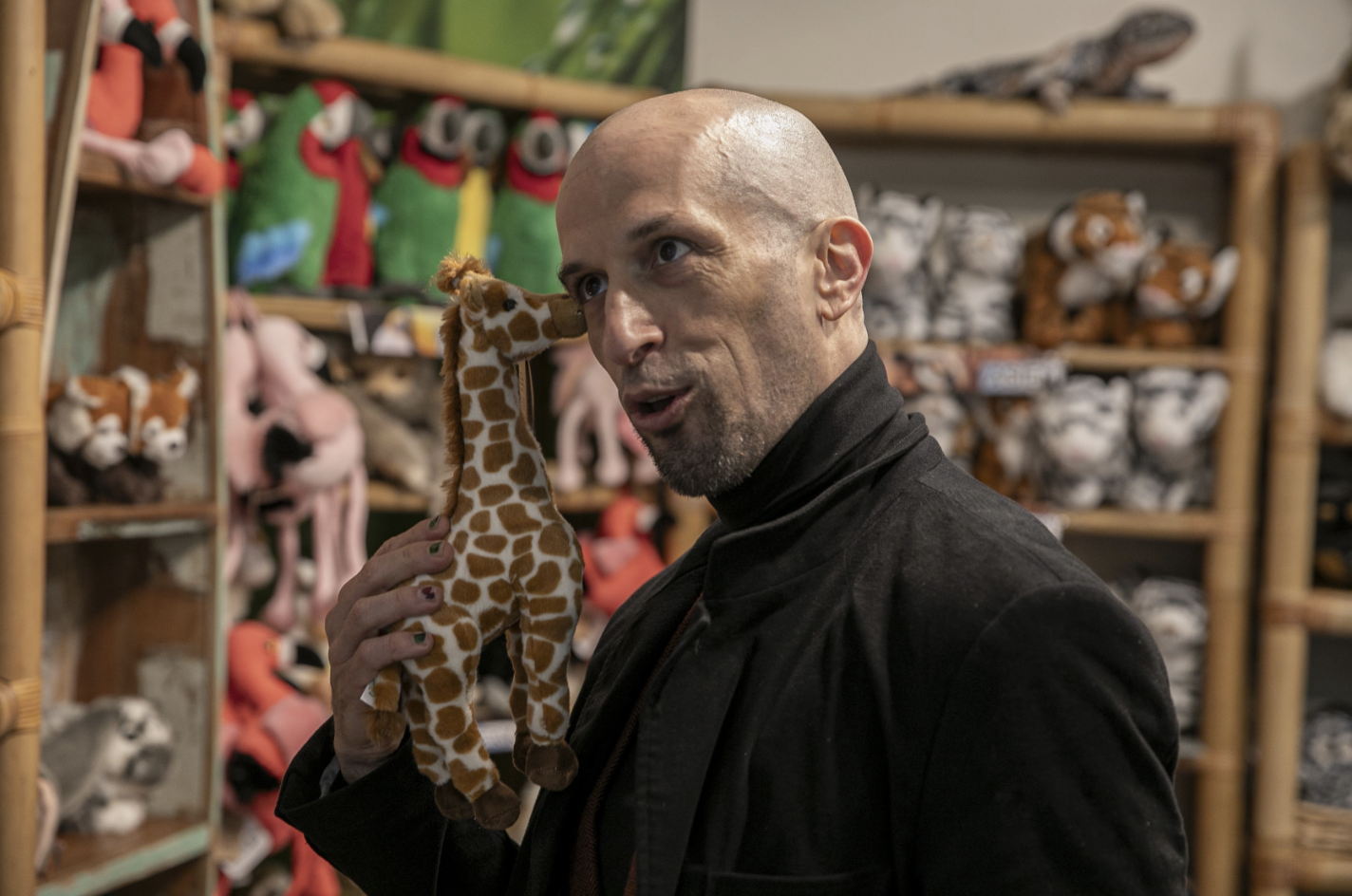
A special moment in our rehearsals is the scene “I’d rather”. Three characters sit together, drink slivovitz, translate for one another, play a radical truth game. In different languages, they say what they would rather do, suffer, or lose than accept what they are currently living. The statements become more absurd, sarcastic, political. One character says: “I’d rather carry your burden than face my guilt.” Another: “I’d rather be a giraffe.”
STEVAN
I would rather be a giraffe.
Kathi and Pete look at him. They wait for the second half of the sentence.
STEVAN
I would rather be a giraffe. Period. I would rather be an animal in the savanna or an elephant in Tito’s zoo. Or the louse in his garment than this pathetic little photographer who never opened his mouth and is now managing the ruins of his own utopia. As a giraffe, I would have had completely different possibilities.
A transformation follows: the character Stevan puts on a giraffe costume and gives a speech. The scene ends with an absurd monologue about diplomacy, hotel lobbies, and the failure of the Non-Aligned Movement. It is theatre, grotesque, lament, political cabaret. And, at the same time, a moment of truth and authenticity.
As we work on the second version of the text, we collect feedback. Our colleague Rinus Silzle from the Munich Network of Theatre Writers (Netzwerk Münchner Theatertexter*innen) analysed the text closely: Which scenes are clear to the audience? Where do we need more context, more rhythm, more specificity? His external perspective helped us identify blind spots.
Historical legacies
An especially eye-opening moment came during acting coaching with Jelena Kuljić from the Münchner Kammerspiele. Jelena, herself from the former Yugoslavia, asked questions from the characters’ perspectives. What is their motivation? Where do they come from? Why do they speak the way they do? Through her guidance, we brought scenes to life that had felt dry on the page. What emerged was intimacy, urgency, a physical connection.
Because we are not only writing, but also directing and performing, this kind of support was essential. Jelena helped us visualize ourselves – not as writers, but as characters, with posture, gestures, intention. Once again, it became clear: writing is not a finished act, but a constantly shifting relationship between word and body, thought and space.
THIS PLOT IS NOT FOR SALE is also a reckoning with historical legacies: with representation and appropriation, with migration history, with our parents' utopias and the cynicism of the present. Who gets to shape the future? What does international solidarity mean today? What should we do with “inherited images”? The project doesn’t ask these questions academically, but theatrically, poetically, performatively – and sometimes: angrily.
Perhaps that is the real plot that isn’t for sale: the moment when something emerges that cannot be calculated, controlled, or possessed. A moment of true encounter. Between memory and utopia. Between people who listen to each other. Or pretend to.
And as I live this creative process – the shifting viewpoints, the languages, the rehearsals – I think: yes, in part it is a reenactment. But not a nostalgic one. Rather one that looks forward. What can we make from history? How can it be transformed? And what remains, if we let it go?
Perhaps only a sentence. A sound. A glance through a keyhole – like the one from photographer Stevan. And a giraffe that looks back.
“The real trick of photography – it forces us to look through a keyhole. Keeping the eye open until it hurts may be the only thing we can do.”
About Denijen Pauljević
Denijen Pauljević was born in Belgrade, Yugoslavia, and lives in Munich. He is a writer, theatre-maker, curator, and performer. His work combines multilingual storytelling with documentary and autofictional approaches.
In 2015 he taught screenwriting at the University of Television and Film Munich, and since 2021 he has taught scenic writing at LMU Munich. His debut radio play Das Schneckengrabhaus was named Radio Play of the Month in January 2022. Since 2019 he has been a member of the Munich Theatre Writers' Network (Netzwerk Münchner Theatertexter*innen) and co-leads the cultural department at Bellevue di Monaco.
Cooperation with Literaturportal Bayern
This text was created in cooperation with Literaturportal Bayern. Literaturportal Bayern is supporting this project both in terms of reporting on the performance in autumn and promoting it in advance by asking the three authors involved to reflect on their work in essays.
